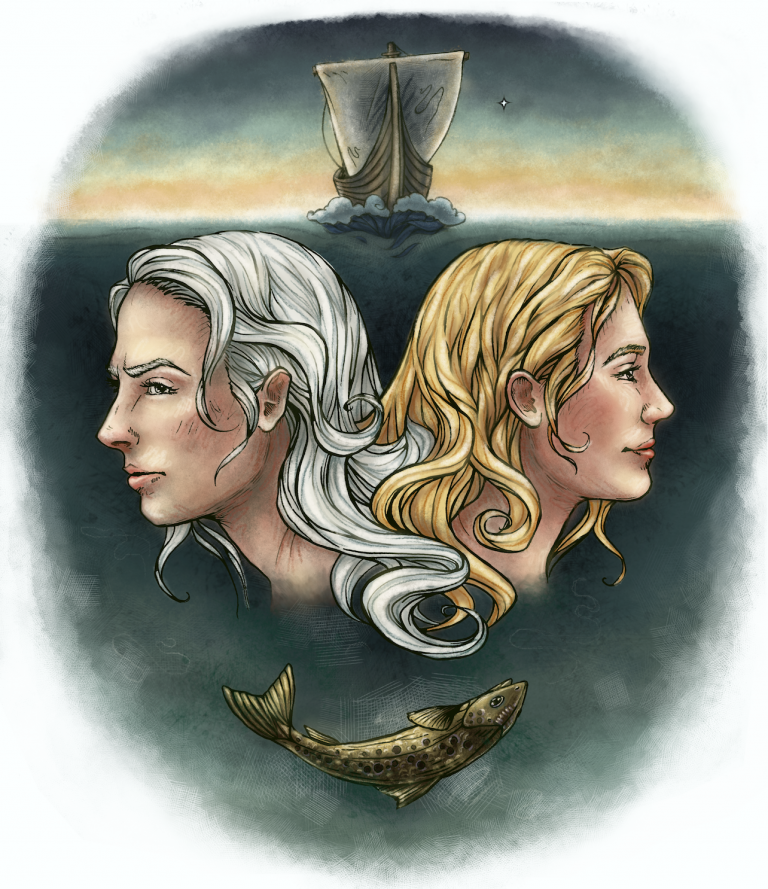
The Nuckelavee

It had been a conversation of escalation. One word had fallen from his wife’s mouth that had marked it as the last conversation for five decades to come.
‘Tha Sìth crosta.’

By Catherine Cuypers
Rain pellets from the Orkney skies, soaking through an old farmer’s clothes as he hurries across his fields, dragging himself along by way of an old walking stick. The grasslands have turned into a bog, his trek more sludge than tread sinking every single step deeper into the mud.
He curses the weather under his breath—a grumble as much as a rasp—and the bloody sheep he has gone out into the dark to find.
‘Mabel,’ he shouts, ‘where are ye?’
Sometimes his sheep answer. Responsive bleats traveling through the high grasses and heather. He has long found that his flock provides better conversational partners than most of the kooks living in the village.
Tonight, the storm drowns out any answer his wayward Mabel might give.
The only response he is given, is the grumble of his own disdain. In canon with the thunder that echoes through the air in the wake of a lightning strike that is too close for comfort.
His lantern is the pendulum of a broken clock, swinging jaggedly and too fast as he fights against the environment slowing him down. The light supposed to trap his eejit sheep in its cast. Terminating this fool’s errand.
Instead, it shows him slivers of the landscape. The heather is lacklustre purple in the dark, nowhere near its vivid state from earlier that day.
In the distance, he hears it, hounds him on from afar: the heavy weight of silence rattling through the night on a collective intake of breath, like the snuffing of a candle; the townsfolk’s hand a whip crack as they slam their windows shut as one. Shutters and doors falling closed to the blow of an open palm, the sound of trepidation pitching into the overcast night sky.
The sound of time running at an end.
Folklore’s waking drum, the pin slipping from the candle into the brass tray.
The town had learned to heed the storm-clad winter nights since long before they could utter words to explain the superstition bolting their houses the way they do. When a tempest blows across their moors, twisters eddying over the North Sea, the houses will be shut, locks bolted with keys or forced without.
The farmer has lived in the village for longer than he hasn’t, Norn never coming as easily as his English or Scottish Gaelic, his mouth tasting for his Skye roots still. The things one trades to follow another through the world. It brought him to the Orkneys many moons ago, where he will continue to live until he blows his final breath among its sanded and cobbled streets. And even after he has passed into the realm beyond the Veil, he still will not fall for the superstitions the Orcadians fear themselves into fools with.
He does not believe the stories of old the villagers tell themselves on rainy nights like these.
And yet… something of the hive mind fools him into the occasional fugue state, fear not his own leaking into him, leading him to the cusp of almost believing there is something that hounds the village on nights like these that is better not crossed.
‘Mabel—’
Again, his old rasp gurgling along with the river the rain is making of the streets, occluding the light from the candles glowing beneath shutter crevices and behind doors in the distance. Annoyance marks his voice as much as his urgence does. It is already more words than he usually offers his wife; anyone. The former the reason behind this trek, for she was the one to notice the missing cattle in the first place.
He’d cursed at his betrothed as if she’d been the one to leave the pen open. Lord knows it was his own head that did it, the bouts of forgetting that sometimes have him transfixed in the middle of his fields, not knowing where he is or how he got there until he does.
He tells no one of those spells.
Every step waterboards the dry out of him, slowing him down. Rain pouring from his face as much as it does from the skies. As if nature itself attempts to become one with him.
Darkness unspools itself with each lightning strike, he uses the momentum of the temporarily luminous dark to scour his fields. He can almost hear his neighbours’ whispers, even this far out. ‘Warnings,’ they’d call it. Advice of goodwill. Such superstition has fed him all these years that it’s like preternatural voices now hounding about his head looking to suffocate his sanity.
The farmer had had his time of telling those stories himself once, and what good had it done him; what good had his passing on of them done him. He’d never believed, but he’d humoured his wife who did, who had told him there were certain things he had to adapt to if he were to move to the Orkneys with her.
Things that had become stories, to then become the dark thing that had slowly begun to share their bed, their meals, their life. Until he’d kicked it out on the curb, threatening to do the same to his wife.
‘Tha mi trang,’ he’d told her one night after she’d tried to talk to him once again. To get something more out of him than the silence that held between loaded and empty for nearly a year at that point. To get anything out of him that was not the space in their midst. The empty seat at a table bearing three chairs, seating only two.
He’d once felt, and a good deal more than most people. Some might have called him gentle, sensitive even. But the well of emotions he’d once held had evaporated. No trace of all the feelings that once sat bottled up inside of him remained. Their vapor had run down his inner walls, puddling at his core in the only emotion that knew to remain: anger.
‘Chan eil,’ his wife had replied, her tongue struggling around the Scottish Gaelic she’d learned for him so long ago, a curtness and anger in her voice he had not heard in her for months at the time. For the duration of a loss unnameable. When she’d still had the bite to her being, the islander fire that had been flickering already then, sparking into one last blaze. As if her speaking of it now might clock him with the severity of it all. ‘Chan eil thu trang. Tha thu brònach agus sgìth.’
It had been a conversation of escalation. One word had fallen from his wife’s mouth that had marked it as the last conversation for five decades to come.
‘Tha Sìth crosta.’
Of course, she’d sounded near-native flawless in pronouncing that one syllable.
Sìth.
Five decades silenced on that one word.
Until tonight.
Until the bloody sheep had to go and seek death in this unforgiving weather. To remind him of the stupidity of this town.
His wife, at least, had known better than to curb him. She hadn’t needed to tell him she’d lock the doors, bolt the latches as soon as he’d cross the threshold into the rain. How she would hold fast to her knocks and rhythms for situations like these. Personalised knocks she’d await when he came back home and make himself known. Patterns to let your loved ones know it was you who came knocking rather and not the Good Neighbours pretending at being you.
He could see her in his mind’s eye as he went. How she’d light the candles behind their now shuttered windowsills. How she and the other villagers were saying grace to Mither O’ the Sea to keep the horror of these parts of Scotland at bay.
He had lit them once, too. Had carried candle stubs and matches in his pockets, switching them out after every final use until his belief had ended up belying and betraying him. His pockets had grown lighter, his belief non-existent.
Another lightning strike casts the world in temporary light, long enough for him to see his sheep cowering in the storm, face pressed into grasses flattened against the earth. An equine silhouette stands a little distance away. More cattle has escaped it appears.
‘Mabel?’ his anger has turned into desperation. When he looks back, he can barely make out where his village is. He turns back in the dark, towards where he thought the sheep to have been just then. ‘Come here you dastard sheep!’
Something carries on the waves of the storm-driven waters. A putrid smell like rotting fish and decaying greenery, natural smells drawn out to unnatural extent. The ocean growing too big to remain in its place, bringing with it things not for the land.
The old man takes another step forward, forgetting to test the terrain with his stick before he moves. The ground is further off than he’d anticipated. A hollow in the earth twists his ankles and sends him plummeting. His walking stick, the weight too sudden, cracks in synchronisation to the thunder renting the air, the lightning bolt is mere seconds off, and his lantern collapses on the boggy land. The world is too wet for fire to catch.
The light goes out.
There is night. There is rain. There is the old man looking at the sky that is dark. There is no one who will come to get him.
He remembers her like it has not been over fifty years; remembers the storm that had raged those five decades ago and him outside then with a lantern, too, yelling over wind and rain.
His wife had ushered him back into the house at the time, telling him it was no use. That they’d have to wait until morning. The farmer, not quite as old back then, had not listened and had fled from their house, wielding that very same lantern. Not yet a cane needed. A drag and pull in the fields had brought him back, the sheep bleating in their pens as if they also realised all was not right.
The farmer had yelled and fought in his neighbours’ arms as he’d been dragged back inside his home by them. Back when he’d still went to the pub drinking with his fellow town folk, when he was part of a community he had torn apart singlehandedly after that night.
They’d cast him into the parlour of their house and thrown the door shut behind them, his wife in tow, wielding the housekey as she bolted the door.
Profanities that still echoed between them even now had left his lips as he fought against the strong arms that held him away from the door each time he ventured too close. Even when knocks had sounded, screams which he’d sworn were his daughter’s that mingled with his own as he pleaded for anyone to open the door.
His wife who had levelled his gaze and told him, ‘She knows her knocks, that is not her pattern. That is not our daughter.’
Morning had come and he’d gone out into world which had been dry rather than sodden. Flooded in offensive sunlight. Birds twittering in the trees and the fields, the waves breaking on the shore. The postcard-like scenery had mocked him as he’d combed through the whole of the island, down every alleyway of the village. Looking out at the waves as if his daughter might come up with the next white horse.
He had found nothing, not a single sign of his child who had gone out moments before the storm had hit the night before. When he’d ran into the fields, spurred on by the legends he’d been fed for a decade at that point, which he’d never quite believed, but in that moment felt as true as his fear was.
The police had already been contacted when he got back to his home, hours later, night once more falling, cloudless, no rain to be sensed.
Nothing, they’d said, no sign of her.
Weeks later, a man was apprehended, incarcerated on the mainland. Their daughter had been found, buried in a nameless grave a wee while outside of the town. The authorities had been looking for the man for a good while, a string of murders that had riddled the islands and mainland authorities for many moons at that point. Murders that had not been made public, bodies mauled and mangled to such an extent that the government did not seek to disclose the horrors taking place in the public’s midst.
His wife’s voice had droned on in the span of those weeks between the there and gone; about Mither O’ the Sea, who would bring their daughter back any day now. Who had protected her during the storm, that it was the Nuckelavee who prowled on nights such as the one they’d lost her on.
The farmer had wanted to believe her, had tried to. Until the authorities had arrived at their doorstep that one morning with a request to come identify a body.
The farmer had told his wife after, when they’d come home and she was sobbing into her green marble pendant, saying words to ancient deities, that if she were to ever speak of the Good Neighbours again, he’d leave her.
The sun began to rise over the world, feet drudging through the world post-storm. The farmer reaches his door, fumbling with his lantern and his cane as he feels for his keys. He remembers he’d left them as he’d run out to find his sheep. His wife would have to open for him.
His hand raps the worn wood that is in need of a lick of paint. Footsteps on the other side draw near, carrying reluctance in their drag and step.
His name on a rise, a question mark dangled at the end, resounds from the other side.
‘Let me in,’ he barks, knocking again, his body sore from a night in the field.
A pause from the other side. ‘Your pattern,’ she demands.
‘You daft woman,’ the farmer growls, reaching to knock again. Hands cold, body aquiver, his lantern slips from his hand, his cane in its wake. The sound of collapse splits apart the world in a string of lightning, the downpour that had never ceased.
There in the field, the farmer wakes from another one of his bouts, a spell of confusion.
Darkness and rain. Thunder rolling. A count. Too close, too close.
Another match strike of lightning.
The equine form he saw earlier stands overhead, breathing clouds into his face, smelling of rot and decay. Of death. A rider whom he had not noticed before on its back.
The farmer does not believe.
It is merely his head he thinks, merely his old age.
Any moment now, his daughter will come and guide him back home. Put Mabel back in her pen.
Any moment.