The Weird of the Three Arrows
As Douglas stared in confusion, the woman let out an almighty laugh. ‘The weird is fulfilled!’

By Rebecca Brown
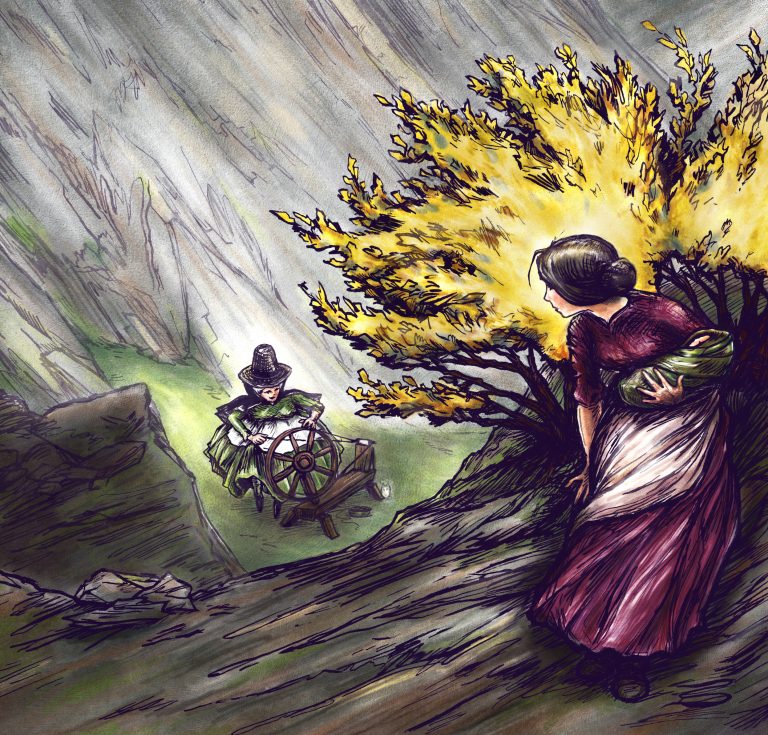
Sir James Douglas, one of Robert the Bruce’s most fearsome and loyal companions, was at rest with his men in Jedburgh after many fierce battles with the English, and many days on the march. As night fell and his men retreated to their tents, Douglas lingered outside to enjoy the quiet evening. He scanned the tree line, and tensed when he saw a shape ambling towards his camp. An enemy, perhaps? Were there English soldiers nearby, ready to spring upon his men and slaughter them in their beds? However, as the figure drew closer, he realised it was an old woman. She staggered, one hand gripping a walking staff, and the other clasping three arrows.
On reaching him, the woman asked, ‘Are you the one they call Black Douglas?’
‘I am,’ Douglas replied. ‘And you are?’
‘I have lived in this area since the day King Alexander passed the door of my cottage with his bonnie French bride, who was scared away by the death’s head that appeared to her on the day of her marriage.’ The woman sighed and looked at the arrows in her hand. ‘What I’ve suffered since then lies between me and heaven.’
‘You have lost sons in the recent wars?’ Douglas asked the woman.
In her gnarled hand, the woman held out one of the three arrows. ‘This arrow carries the blood of my first born.’ She held out the second arrow. ‘This, the blood of my second, and this,’ she held out the third and final arrow, ‘The blood of my third. I am now childless, and I wish to return these arrows to the English, in the manner which they were delivered. With the strongest arm and surest eye in Scotland, who better to return these arrows than you?’
Douglas, though flattered by the woman’s appeal, declined. He was no archer. His days in battle had been spent with an axe or sword in his hand, not a bow. The woman simply told Douglas that she would return on St James’ Eve, and departed, leaving her three arrows behind.
With that, Douglas stored the arrows in an empty quiver, and went to bed.
He was awoken the next morning by a messenger who reported that Sir Thomas Richmont was marching through a narrow pass in the Scottish border with ten thousand men at his back, and seeing an opportunity to have one over on the English, Douglas leapt into action. Without delay, he ordered his troops to march towards the pass, and they twisted together the birch trees either side of the path so that their enemy would have no way to escape. He also had his archers hide near the narrowest point and lie in wait.
On came the English atop their horses, picking their way slowly through the narrowing pass. When they reached the tightest section, the archers loosed their arrows, and Douglas charged in with his men and massacred the English, along with Sir Thomas Richmont, who fell to Douglas’ own blade.
Some time later, the Governor of Berwick and knight of Gascony, Edmund de Cailon, goaded Black Douglas to battle. Douglas got wind of the knight returning to England with an abundance of plunder. Douglas and his men pursued Cailon to the border, and before he could cross, called to him, ‘Come, Cailon, and meet with the Black Knight you were so eager to cross paths with!’
All of Cailon’s previous courage drained away when faced with the formidable Black Douglas, and he ordered his men to attack in his stead. Cailon tried in vain to keep his distance from the fray, but Douglas fought his way to him and faced him in single combat.
‘So much for the vaunt of Cailon,’ Douglas spat once he had felled the Governor and taken his loot.
A third Englishman to face the wrath of Douglas was Sir Ralph Neville, who declared that should Black Douglas show his face in Berwick, he would kill him in single combat. Never one to shy from attention, Douglas marched immediately to Berwick. With him, he took his men, who he ordered to plunder and burn the surrounding villages. High up on a hill, Sir Neville held his troops back, waiting to ambush the Scots as they looted the villages, but Douglas saw through this tactic and called his men to him. As one, they rushed the English forces on the hill, and, like each encounter before, Douglas brought himself face to face with Neville. After a brief skirmish, Douglas emerged the victor.
After so much fighting, Douglas and his army were bone tired and in need of some good rest. They set up camp, and as he often did, Douglas lingered outside his tent after nightfall. It was then that he saw a familiar figure making its way towards him: the old woman whose three sons had died to English soldiers. He’d forgotten about her, but just as she promised, here she was on the Feast of St James.
‘Have you returned those arrows to the English yet?’ she asked.
‘I told you I do not fight with a bow,’ Douglas replied. ‘Here, let me fetch them for you and you can find someone else to return them.’
Douglas retrieved the quiver, but as he passed the arrows over to the woman, he noticed each arrow splintered through the middle. As Douglas stared in confusion, the woman let out an almighty laugh.
‘The weird is fulfilled!’ she cried, and pointed at the first arrow. ‘This arrow came from a soldier of Richmont’s.’ She pointed at the second arrow. ‘This, from a soldier of Cailon’s.’ She pointed at the last broken arrow. ‘And this one, from a soldier of Neville’s. Now, they are dead, and I have my revenge!’
Before Douglas had so much as a chance to react, the woman skipped off into the night, scattering the broken arrows behind her as she went.
Adapted from Folklore and Legends of Scotland by W.W. Gibbings